Therapeutic antibodies are designed to recognize a defined molecular target with high selectivity. This specificity is one of the main reasons antibodies have become important drug molecules across oncology, inflammatory disease, infectious disease, metabolic disease, and other therapeutic areas. However, a candidate that binds its intended antigen with high affinity may still be unsuitable for development if it also interacts with unrelated molecules, aggregates during storage, shows poor solubility, displays high viscosity, or clears too rapidly from circulation.
A useful way to understand this problem is to look at the surface of the antibody. Like all proteins, antibodies are not chemically uniform. Their surfaces contain amino acid residues with different properties: some are charged, some are hydrophobic, some can form hydrogen bonds, and some contain aromatic rings capable of π-stacking interactions. When residues with similar properties cluster together on the antibody surface, they form what are often called surface patches. These patches can become unintended interaction sites.1
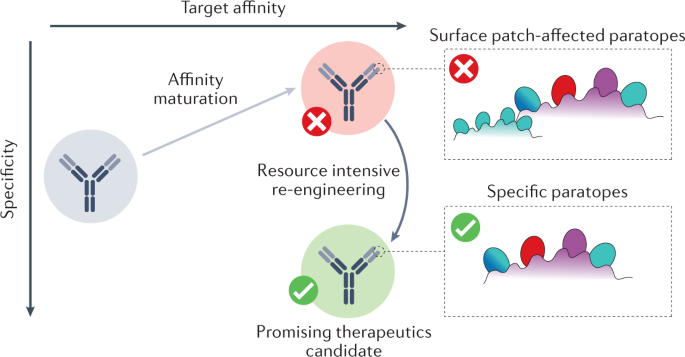
For antibody discovery and engineering, this creates a developability challenge: improving target affinity must be balanced against preserving specificity and acceptable biophysical behavior. Affinity maturation can improve binding to the intended target, but it can also alter the antibody paratope (the antigen-binding surface) in ways that create patch-associated nonspecific interactions. These liabilities may then require re-engineering before a candidate can progress as a therapeutic lead.
Affinity describes how tightly an antibody binds its intended target. In early discovery, high affinity is often desirable because it can improve apparent potency and target engagement. However, affinity is not the same as specificity. An antibody can bind tightly to its intended antigen while also interacting weakly or moderately with unrelated molecules.
These unintended interactions are usually called nonspecific interactions or off-target binding. They may involve cell-surface components, serum proteins, nucleic acids, extracellular matrix molecules, chromatography materials, or other biomolecules encountered during production, formulation, or in vivo administration.
In antibody engineering, the residues that contact the antigen are concentrated in the complementarity-determining regions, or CDRs. These loops form much of the paratope. During affinity maturation, mutations are introduced and selected to improve antigen binding. Some of these mutations can increase favorable interactions with the target. However, they can also change the local surface chemistry of the antibody. For example, they may increase hydrophobic surface exposure, create a positively charged region, or cluster residues capable of forming multiple weak contacts with unrelated molecules.
This is why developability assessment must consider more than antigen binding. A candidate must bind the correct target, avoid problematic nonspecific interactions, remain stable during manufacturing and storage, and retain favorable pharmacokinetic behavior.
A surface patch is a continuous area on the protein surface enriched in residues with related physicochemical properties. The most relevant classes for antibody developability include:
Hydrophobic patches, which contain residues that prefer to avoid water. These regions can promote self-association or binding to hydrophobic regions of other molecules.
Positively charged patches, which can interact with negatively charged molecules such as nucleic acids, acidic polysaccharides, or cell-surface components.
Negatively charged patches, which can interact with positively charged surfaces or protein regions.
Polar or hydrogen-bonding patches, which may form multiple weak contacts with compatible molecules.
Aromatic patches, which contain residues such as phenylalanine, tyrosine, or tryptophan and may participate in π-stacking or hydrophobic interactions.
A single amino acid substitution may not seem like much when viewed only as a sequence change. However, in a folded antibody, residues that are distant in sequence can be adjacent in three-dimensional space. Several substitutions can therefore combine to create a chemically coherent patch on the surface. This is one reason structure-based and surface-based analysis can reveal liabilities that are not obvious from sequence inspection alone.
Nonspecific binding is usually not caused by a single strong interaction. More often, it arises from several weak interactions acting together. These can include electrostatic attraction, hydrophobic contacts, hydrogen bonding, dipole-dipole interactions, and π-stacking.
A recent study provides a direct experimental example.2 The authors used a designed antibody library to examine how surface patch properties influence nonspecific binding to single-stranded DNA. DNA served as a model nonspecificity ligand because it is negatively charged and can expose nucleobases that participate in additional molecular interactions. Using an in-solution microfluidic method, the study measured antibody-DNA binding without relying on surface immobilization. The authors reported that some antibodies bound single-stranded DNA with micromolar apparent affinity, and that under physiological salt conditions this nonspecific binding was primarily associated with a hydrophobic patch located in the CDRs.
This finding is important because it shows that the relevant behavior under physiological salt conditions correlated with a CDR-localized hydrophobic patch rather than overall net charge alone. In other words, where the chemical features are located on the antibody surface can matter more than the total number of charged or hydrophobic residues.
The same study also examined what happens under lower ionic strength conditions. In that setting, electrostatic interactions became more influential, and DNA-induced antibody phase separation was observed. Phase separation occurs when molecules demix from solution into a more concentrated phase, similar in broad physical principle to droplets forming in a mixture. In antibody development, phase separation can be problematic because it reflects altered solution behavior and may relate to formulation instability. The authors linked this low-salt behavior to cooperative electrostatic network assembly involving antibodies and DNA.
This does not mean that every antibody with a surface patch will phase separate, nor that DNA binding alone predicts clinical performance. Rather, the study demonstrates a connection between molecular surface features, nonspecific interactions, and macroscopic solution behavior in a controlled model system.

Surface patch-mediated nonspecificity can influence multiple stages of antibody development.
One consequence is self-association. If an antibody surface contains regions that interact with similar regions on neighboring antibody molecules, the molecules may cluster. This can contribute to aggregation, opalescence, or increased viscosity. High viscosity is particularly relevant for concentrated antibody formulations, especially when subcutaneous delivery is intended.
Another consequence is reduced solubility. Hydrophobic patches or complementary charged regions can promote intermolecular contacts that reduce the amount of antibody that remains well dispersed in solution.
A third consequence is altered pharmacokinetics. Antibodies that interact nonspecifically with cell surfaces or extracellular components may be cleared more rapidly than expected. The relationship between surface properties and in vivo behavior is complex, but experimental developability assays often use surrogate readouts to identify candidates with elevated nonspecific interaction risk.
Another paper describes PEP-Patch as a tool for visualizing and quantifying electrostatic surface patches on proteins.3 The tool identifies continuous positive or negative regions on the protein surface and can report patch properties such as area and contributing residues. The paper applies this approach to protein recognition and antibody developability, including analysis related to heparin chromatography retention, which is used as a developability-associated readout connected to antibody pharmacokinetic behavior.
This type of analysis is valuable because it moves beyond global descriptors such as net charge or isoelectric point. Two antibodies may have similar net charge but very different surface charge distributions. One may display charge dispersed across the molecule, while another may contain a large localized positive patch. These two surfaces can behave differently in solution and in biological environments.

The paratope is the antibody region responsible for antigen recognition. Because it is designed or selected for binding, it frequently contains chemically active features. CDR loops may include aromatic residues, hydrophobic residues, charged residues, and polar groups arranged to complement the antigen surface.
Thus, the same features for target recognition can also mediate unintended interactions if they are not sufficiently specific to the antigen. Affinity maturation may intensify this issue when mutations increase the strength or size of interaction-prone patches.
The surface patch framework should be used carefully as not every hydrophobic, charged, or polar region is problematic. The effect of a patch depends on its size, location, chemical composition, structural context, solvent exposure, conformational flexibility, formulation environment, and the molecules encountered during manufacturing or administration.
Likewise, a single assay cannot define developability. DNA binding, heparin retention, self-association, thermal stability, and viscosity each report on different aspects of antibody behavior. The most reliable candidate selection strategies combine multiple orthogonal measurements with sequence- and structure-based interpretation.
The current literature supports a clear but measured conclusion: surface patches are important contributors to antibody nonspecificity and can help explain how molecular features translate into developability-relevant behavior. They are not the only determinant of antibody success, but they provide a useful framework for connecting affinity maturation, specificity, biophysical stability, and formulation performance.
Therapeutic antibody development requires more than high-affinity target binding. Antibody surfaces contain chemically distinct regions that can create unintended interaction sites. When hydrophobic, charged, polar, or aromatic residues cluster into surface patches, they may promote nonspecific binding, self-association, altered solution behavior, or pharmacokinetic liabilities.
The studies discussed here show why surface patch analysis is increasingly useful in antibody developability assessment. Experimental work links defined antibody surface patches to nonspecific binding and phase separation in model systems, while computational tools such as PEP-Patch provide ways to visualize and quantify electrostatic patch features.
For antibody discovery and engineering teams, the practical lesson is straightforward: affinity maturation should be paired with specificity and developability assessment. The most promising therapeutic candidates are not simply those that bind most tightly, but those that combine target engagement with controlled nonspecificity, robust expression, stable formulation behavior, and manufacturability.
Ausserwöger, H., Schneider, M. M., Herling, T. W., Arosio, P., Invernizzi, G., Knowles, T. P., & Lorenzen, N. (2022). Non-specificity as the sticky problem in therapeutic antibody development. Nature Reviews Chemistry, 6(12), 844-861. https://doi.org/10.1038/s41570-022-00438-x
Ausserwöger, H., Krainer, G., Welsh, T. J., Thorsteinson, N., De Csilléry, E., Sneideris, T., Schneider, M. M., Egebjerg, T., Invernizzi, G., Herling, T. W., Lorenzen, N., & Knowles, T. P. (2023). Surface patches induce nonspecific binding and phase separation of antibodies. Proceedings of the National Academy of Sciences, 120(15), e2210332120. https://doi.org/10.1073/pnas.2210332120
Hoerschinger, V. J., Waibl, F., Pomarici, N. D., Loeffler, J. R., Deane, C. M., Georges, G., Kettenberger, H., Fernández-Quintero, M. L., & Liedl, K. R. (2023). PEP-Patch: Electrostatics in Protein–Protein Recognition, Specificity, and Antibody Developability. Journal of Chemical Information and Modeling, 63(22), 6964–6971. https://doi.org/10.1021/acs.jcim.3c01490
In this article, we explore the major trends shaping the future of targeted canc……
Site-specific conjugation limits payload attachment to defined positions on the ……
ADC development is no longer limited to the antibody-linker-toxin model. The fie……